Supermarket Facelift (a work in progress)
MAKING THE SUPERMARKET ABOUT NUTRITION
Index
Proposal
Initial Concept Exploration
Poster
Poster Revisions
Organization Blueprints
Dissecting The Circular
Supermarket Research - Under the Skin
Recipe Section
Organization & Mark Exploration
Refinement
Proposal
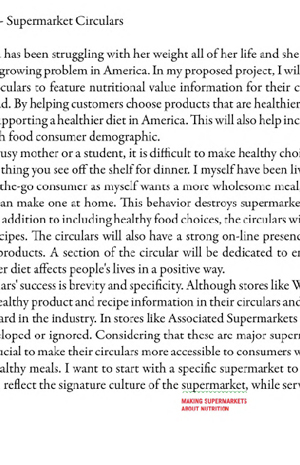
My friend Samantha has been struggling with her weight all of her life and she is not the only one. Obesity is becoming an ever-growing problem in America. In my proposed project, I will work with supermarkets on redesigning their circulars to feature nutritional value information for their customers in a format that is quick and easy to read. By helping customers choose products that are healthier and more nutritious, the supermarkets will be supporting a healthier diet in America.
This will also help increase the supermarkets' share of the growing health food consumer demographic. Whether you are a busy mother or a student, it is difficult to make healthy choices when you have five minutes to grab the first thing you see off the shelf for dinner. I myself have been living on hot dogs for the past week. If such an on-the-go consumer as myself wants a more wholesome meal, she is more likely to go out for a meal, rather than make one at home. This behavior destroys supermarket sales and my proposal will change this trend. In addition to including healthy food choicePos, the circulars will feature quick, inexpensive, and healthy meal recipes. The circulars will also have a strong on-line presence with recipe ideas and discounts for in-store products. A section of the circular will be dedicated to encouragement and feedback about how a healthier diet affects people's lives in a positive way.
The key to the circulars' success is brevity and specificity. Although stores like Whole Foods have made steps towards including healthy product and recipe information in their circulars and in their online content, this practice is not standard in the industry. In stores like Associated Supermarkets and Waldbaum's, these ideas are either underdeveloped or ignored. Considering that these are major supermarkets serving large metropolitan areas, it is crucial to make their circulars more accessible to consumers who wish to purchase healthy food and prepare healthy meals. I want to start with a specific supermarket to realize this proposal. In this way, the circular will reflect the signature culture of the supermarket, while serving as a nutritional guide to its customers.
Initial Concept Exploration
These initial concepts were born at the beginning of my junior year at SVA. I wanted to reference them as my basis for the new design of the circular.

Poster
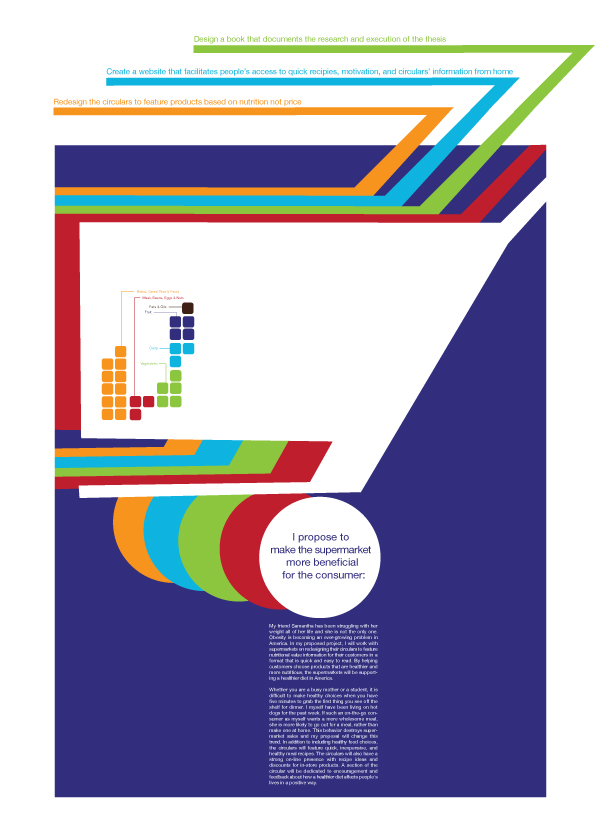
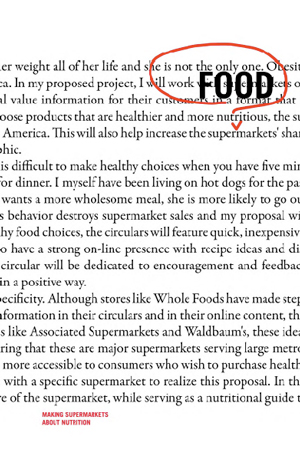
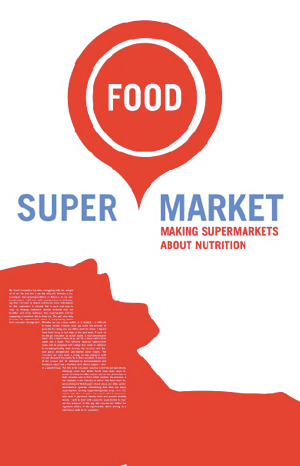
The poster is a summation of the thesis to the public. It contains the full statement about the thesis, but also represent the visual style of the work that is to be created. This was a visual plan for me and showcased the directions I wanted the topic to expand.
Poster Revisions
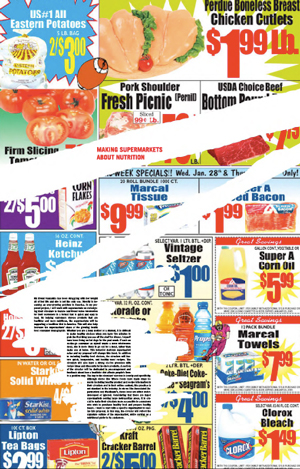
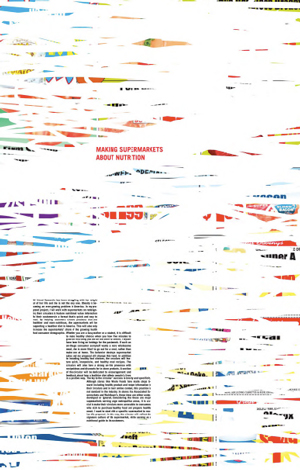
After thinking about the original poster I realized that it lacked feeling and a central concept. I really wanted to make the idea of FOOD and nutrition stand out, as if it was sucked out of the original meaning of the supermarket. This was translated in the incorrectness of the word Supermarket itself in the first two posters. The last two were a demonstration of my feelings about the current circulars and my frustration with its disorganization. I want to erase the content, as I would rather stare at a blank piece of paper than the current mess of information.
Organizational Blueprints
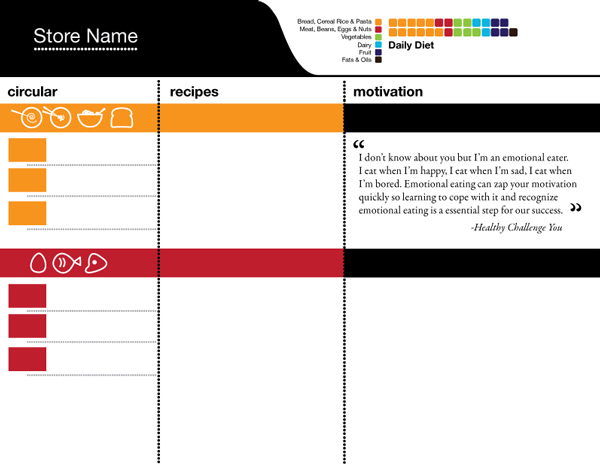
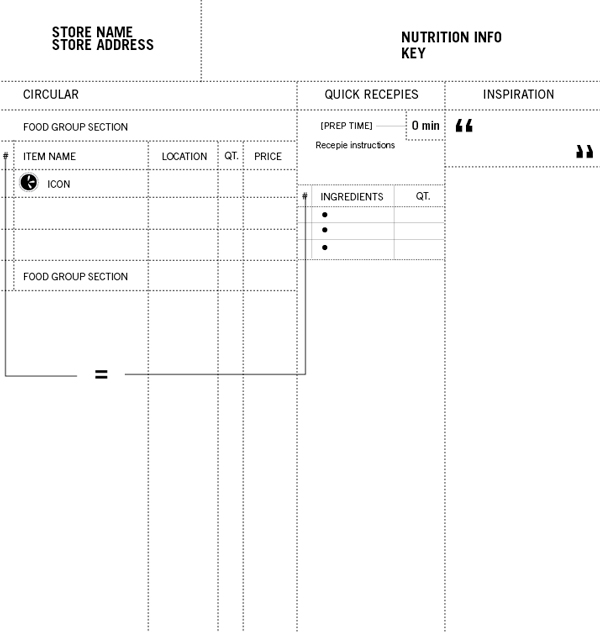
It was difficult for me to initiate the actual design of the circular from scratch so I decided to make a blueprint for myself of how the information would be organized. After completion the feedback was that the piece was too complex. Thus should be simplified and also be more realistic (images rather than icons; the circular, the recipes, and the inspiration separated appearing on different pages)
** Feedback is just as important as concept**
**Failure is just as important as success**
Back to the drawing board...
Dissecting the Circular
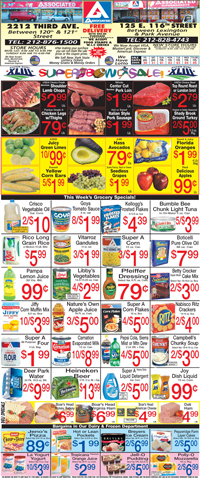
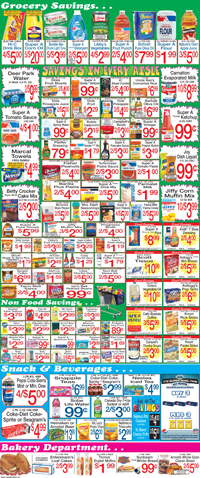
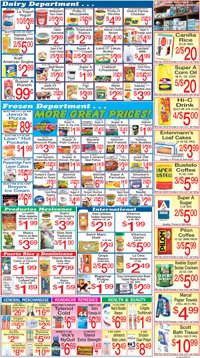
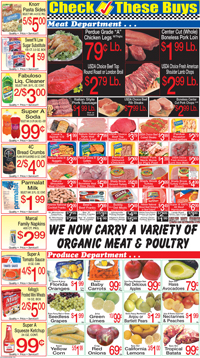
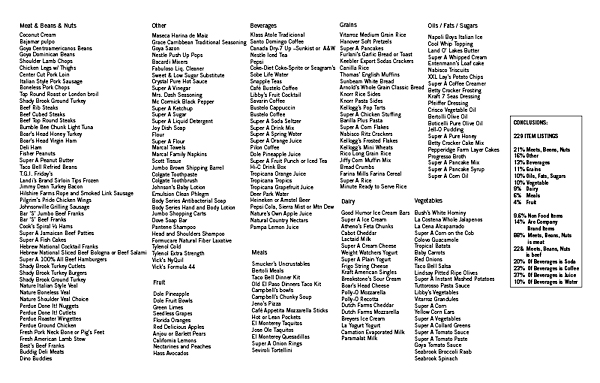
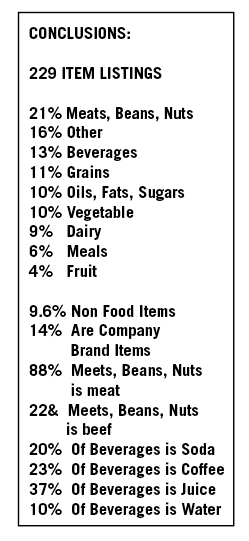
Before you try to fix something that is broken you need to look at and examine it. I took the circular and stripped it of all of the colorful imagery and grouped the items into 9 categories: (Meat, Beans & Nuts), Other, Beverages, Grains, (Oils, Fats & Sugars), Fruit, Meals, Vegetables, and Other. The circular contained 229 items distributed over 4 pages. Some items reappeared two or three times and only 4% of the circular was dedicated to fruit, a major food group. This will have a big impact on what order the groups appear on the redesigned circular.
Supermarket Research - Under the Skin
Field Research
Thinking that the most logical place to start would be the supermarkets themselves I started by calling to find out about their process of creating the circulars. Among the big names like King Kullen, Associated Supermarkets and Stop & Shop I got vague responses like "we use other vendors" or "I don't know anything about that" or " I am not allowed to give out that information". So I decided to look for companies that actually worked with the supermarkets. Here I was a bit more successful. The typical process was described to me as follows: the designer would receive a list of items from the supermarket company; they would design the circular using Quark Express and then send samples to the supermarket company for revisions; after items were added or removed the circular would be reorganized and sent to a printer chosen by the design company (often the design company never saw the finished product and had to use cheap paper, such as newsprint for production).
Web Research
"Grocery retailers spend some $8 billion on feature ads each year, which amounts to 2 percent of their sales -- almost the same amount as their net profit margin."
"10 percent of shoppers chose their store based on the week's ads."
"costumers were most influenced when the ads promoted discounts on cereal, snack chips, pizza, cookies, and hot dogs."
Business Wire,
August 15, 2006
http://findarticles.com/p/articles/mi_m0EIN/is_/ai_n26958103
'"Bulk buying, it turns out, is often more expensive, simply because in the early 1990s supermarket chains figured out that consumers lean toward it, and they've jacked up prices accordingly. "Supermarkets know that consumers believe a two-pound package is cheaper, ounce per ounce, than a one-pound package," says Arun K. Jain, a marketing professor at the State University of New York at Buffalo."'
"Shoppers who stick to a prepared shopping list are few and far between — and they're also the supermarket's worst enemy."
"There's a reason those ovens are always on full blast. "Studies show the smell of baking bread drives people bonkers," says Jain. The scent drives up sales all over the store."
Supermarket Follies,
Saturday, July 15, 2006
Anne Kadet
http://supermarketfollies.blogspot.com/2006/07/ten-things-your-supermarket-doesnt.html
Other sites used for reference:
http://www.mypyramid.gov/
http://www.helpguide.org/life/healthy_recipes.htm
http://www.freshdirect.com/index.jsp
http://www.wholefoodsmarket.com/
Coupon History
1894: The year that coupons were born. After purchasing the formula for Coca-Cola for $2,300, Asa Candler creates and distributes hand written tickets for a free glass of his new fountain drink.
1895: The year the first grocery coupon is born. C.W. Post creates and distributes a one-cent coupon for his new health cereal, Grape Nuts.
1930’s: Coupons come into their own as many households look to save money any way they can during the Great Depression.
1940’s: Supermarkets come on the scene. Coupons make the jump from neighborhood grocery stores to these new regional grocery stores.
1957: Coupons create a new industry as the Nielsen Coupon Clearing House becomes the first company devoted to coupon redemption.
1965: It is estimated that 50% of all Americans use coupons.
1975: Over 35 billion coupons are distributed and the number of households that use coupons rised to an estimated 65%.
1995: The first coupons appear on the Internet.
1998: America celebrates the first National Coupon Month.
2002: Shoppers save and estimated $3 billion dollars by redeeming some 3.8 billion coupons.
2003: The number of households estimated using coupons stands at 77%.
History Of Grocery Coupons
http://www.grocerycouponguide.com/articles/history/
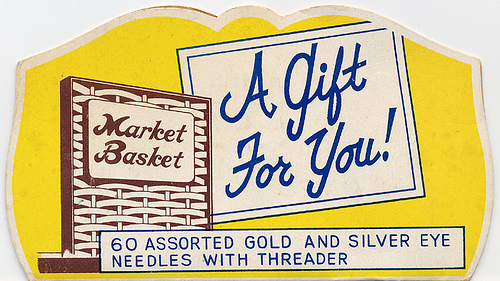
Visual Research Samples (courtesy of flickr)
Recipe Section
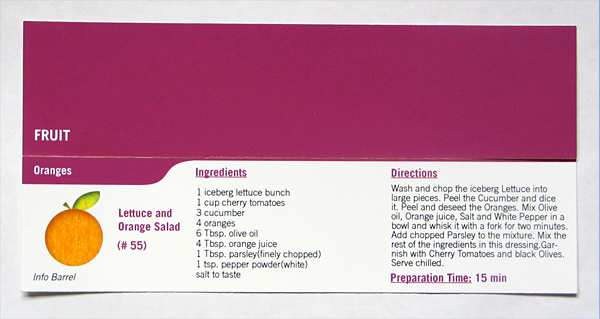
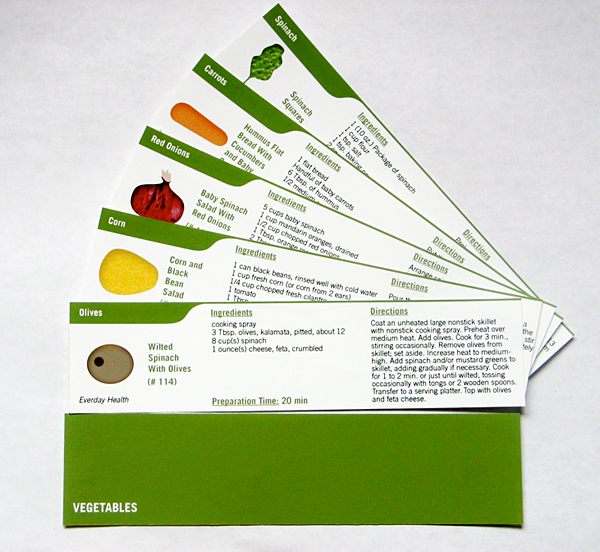
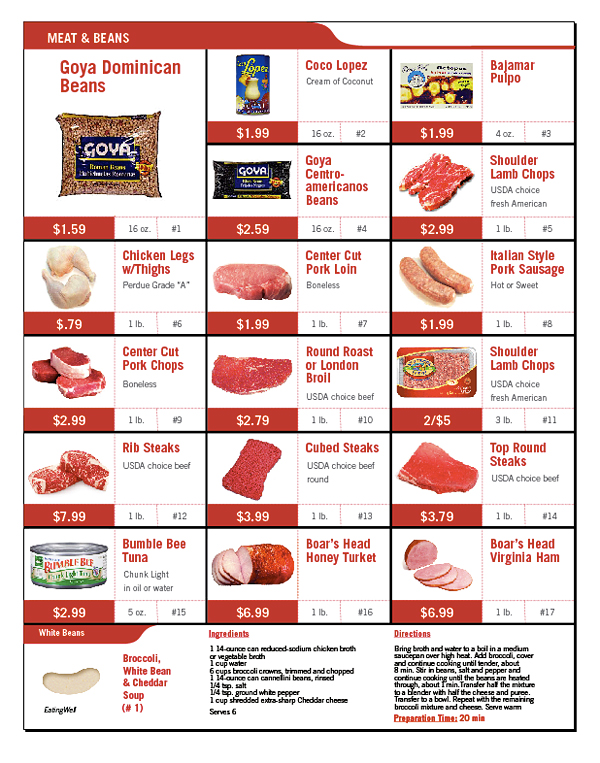
One of the most important sections of the redesigned circular is the recipe section, which connects the items on sale to the ingredient in the recipe. The recipes are quick and easy suggestion for people on a tight schedule. I designed a set of cards that features a recipe, and an illustration of the item. These cards are a demonstration of my visual language for the recipe section.
Organization & Mark Exploration
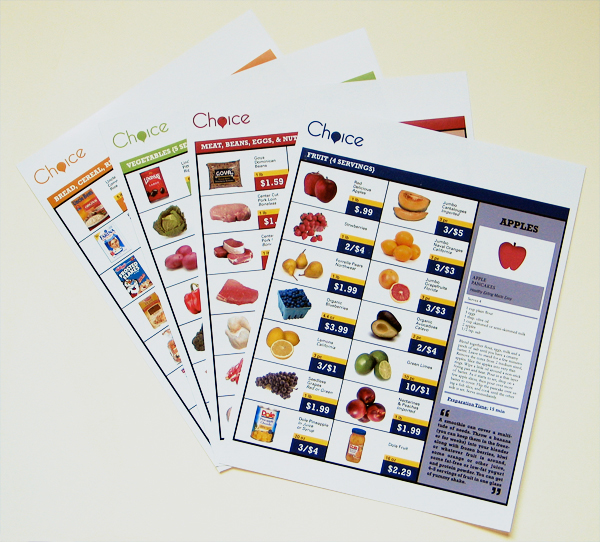
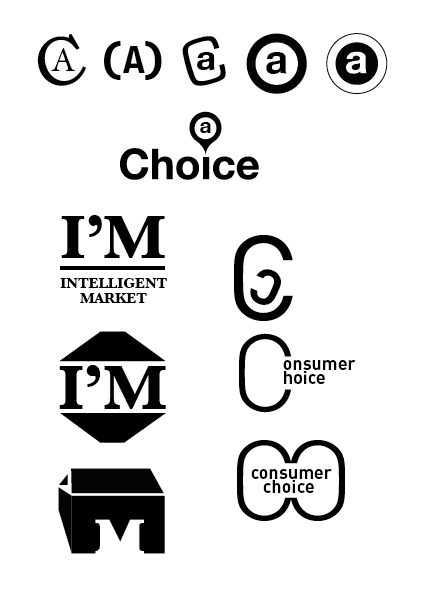
The first concern with the design of the circular was to organize the foods into the individual food groups and create a connection for the costumer through color association. I also wanted to create a way to link the items on sale to the items used in the recipes. I wanted to "package" the circuar with an identity, or a symbol that would represent the choice people had to eat healthy and to buy healthy food at the supermarket without compromising quality.
Refinement
After looking at consumer products and reference material I refined the design to be more freindly and open along with the logo, which was simplified from "A Choice" to "Choice".